


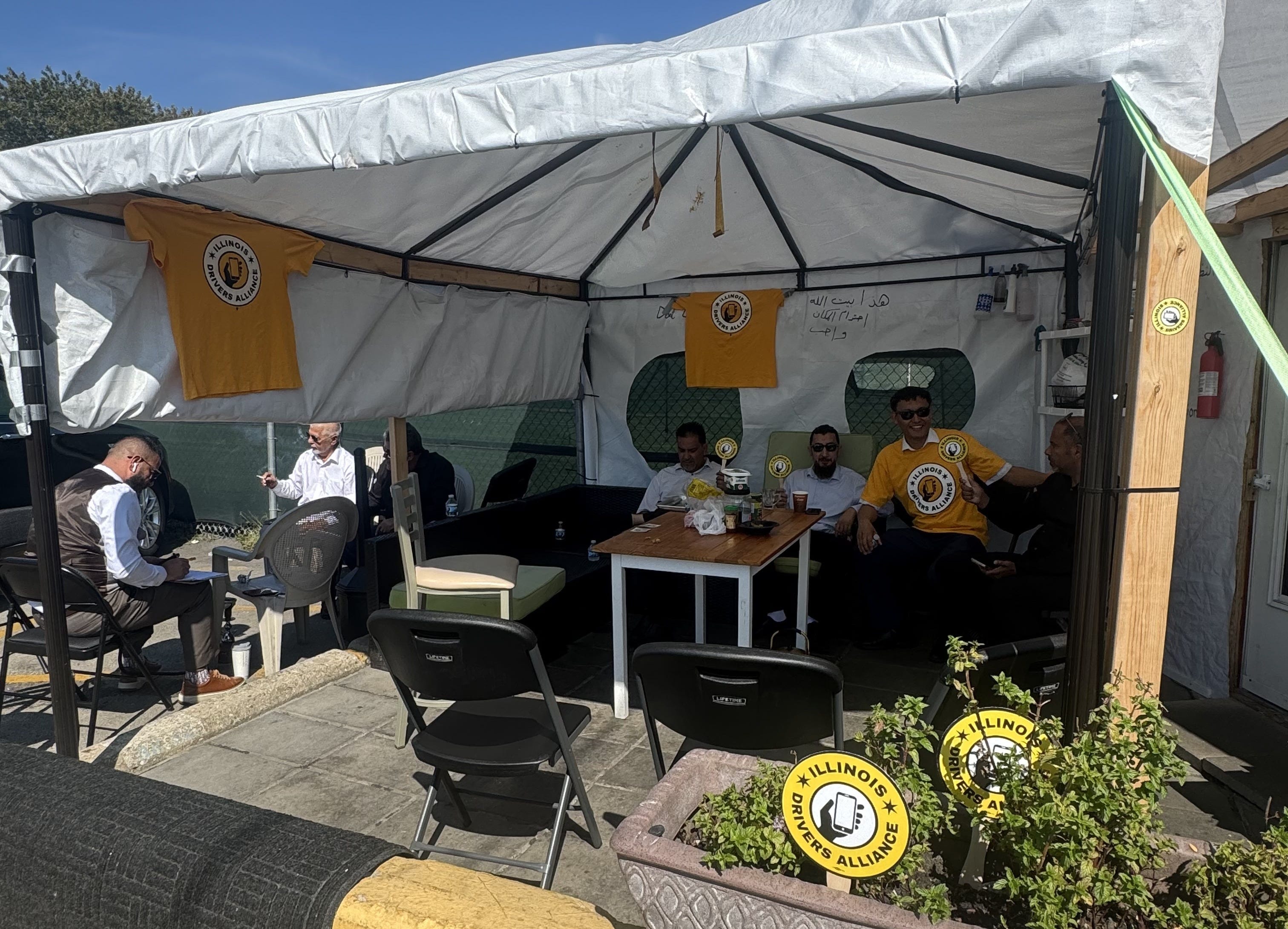
When I joined the labor movement as an organizer with the Service Employees Union on their rideshare campaign in Illinois, on my first day I was sent out to search for potential supporters at the airport. The first thing I noticed when I arrived was the chaos. It was one of the peak periods of the rideshare workday, and the airport’s main staging lot for drivers was packed. Hundreds of drivers competed for limited parking spaces while traffic constantly flowed in and out. As I walked through, I noticed that the drivers came from all over the world. Conversations happened in a multitude of different languages. What also stood out was how isolated everyone seemed. Despite being gathered together in a cramped parking lot, most drivers stayed inside their cars. There were exceptions--groups of Muslim drivers gathering for prayer, small clusters of friends talking around their cars, conversations around the food truck--but the dominant rhythm of the lot was one of isolation. Drivers shared the same space, yet rarely interacted. My first impression was that any effort to organize this workforce would have to overcome not only differences in language and background, but also the isolation built directly into the work itself.
Through this work, I eventually met many remarkable drivers that demonstrated what worker power can accomplish.
One story I’ll tell involves a group of mostly Muslim drivers that were able to hold the airport bureaucracy’s feet to the fire, winning the freedom to construct a community center in their lot. First, I have to give context for who introduced me to them.
I was introduced to these drivers through a contact at a local Kyrgyz community center. By that point, I had learned that many rideshare drivers were Kyrgyz, so I reached out looking for workers to talk to. They connected me with an Uber Black driver, and we met for breakfast at Panera. During our conversation, I learned that he had previously been a Chicago taxi driver and had participated in an AFSCME-backed organizing campaign, even traveling across the country to speak about the drivers’ issues. Although that union campaign eventually ended in failure, the organizing did not end.
The driver I met told me about a spot in the Black Lot where drivers gathered during lunch breaks. I assumed it would be a few disorganized tables around visiting food trucks. When I saw it in person, I was astonished by what the drivers had built. After successfully persuading the airport to set aside a section of unused parking lot where they could lay down prayer mats, a group of mostly Muslim drivers used the space as the foundation for something larger. Through monetary donations from drivers, they crowdfunded the construction of a mosque. Drivers contributed money for prayer mats, walls, air conditioning units, and other building materials, eventually creating a high-quality enclosed tent that was waterproof and able to withstand Chicago’s weather.
Daily prayers drew dozens of drivers, and Friday prayers attracted many more. Muslim drivers from a wide range of backgrounds--Arab, South Asian, Central Asian, and others--passed through the space throughout the day. What surprised me, however, was how the mosque did not just serve a religious purpose but also become a community and mutual aid center for the lot as a whole. Drivers shared meals together, contributed cases of water and supplies for communal use, and befriended one another. I saw drivers stop by simply to socialize, ask for advice, or get assistance with jump-starting their car using the community’s shared jumper cables and tools. Many of these drivers were not Muslim, or from the usual ethnic communities there at all. The mosque sustained itself through voluntary donations from drivers, who collectively maintained the space and funded its operations. As an organizer, I was struck by how many functions it served that are often associated with worker organizations. The drivers had created systems of mutual aid, informal leadership, and voluntary contributions to support the community. Although they did not use the same terms a union would, they referred to themselves in terms like “brotherhood” and were essentially paying voluntary dues. Impressively, in an industry whose labor process is designed around isolation, they had built a center that brought workers together and gave them a collective identity. Many drivers even referred to one of the key organizers of the mosque as the “president of the lot.”
Airport administrators later objected to the mosque’s presence for “fire code” reasons, even though the drivers followed proper regulations. The drivers then responded by bringing media attention to the dispute. The optics of the airport tearing down a mosque forced the admin into a corner. Rather than forcing the mosque’s removal, the airport eventually negotiated a compromise. By the following year, the drivers had secured the use of an actual building, complete with bathrooms, as a permanent home for their community center. Hearing from the drivers about this entire episode was tremendously inspiring in educating me on what workers can accomplish through solidarity and collective action.
As staff of an established labor union, a common tactic we used at the airport lots was carrying around a petition for better bathrooms to start conversations with drivers. It did not lead to anything actually material, because access to the airport property was mediated through a coordinator the union had a careful, ongoing relationship with. By contrast, the rideshare drivers I met demonstrated a different kind of worker power in practice. Through direct, driver-led action, they were able to achieve what established political relationships could not.